


FDM PEEK 3D Printing
FDM 3D PrintingFDM PEEK 3D Printing (Desktop Type&Industrial Type)
Fused deposition modeling, or FDM, is an innovative type of printing that uses additive manufacturing technology to produce 3D objects.
FDM 3D Printing
FDM PEEK 3D Printing
Fused deposition modeling, or FDM, is an innovative type of printing that uses additive manufacturing technology to produce 3D objects. Common applications include prototyping, small-batch manufacturing and hobbyist use.
The term "fused deposition modeling" and its FDM abbreviation are terms trademarked by the developer of the process. Therefore, the term fused filament fabrication, or FFF, is also used as an exact synonym for this type of printing. Both abbreviations and terms are used here. Some also call the process fused filament printing.

Several types of 3D printing have been developed or are in development, but FDM printing remains the most common and cost-effective.
Advantages of FDM 3D Printing
Precision:We use the most advanced industrial FDM 3D printers designed to meet tolerances of +/- 0.004” or +/- 0.002” per inch, whichever is greater.
Strength:FDM printed parts are available in a variety of high-performance plastics for applications that require resistance to the elements.
Large Build:Galaxy3DM can produce FDM parts with large build volumes up to 24″ x 36″ x 36″
Rapid Turnaround:FDM parts do not require tooling which reduces the manufacturing lead time from weeks to days, allowing for faster innovation and speed to market.
Complex Geometry:Geometries that are too complex or costly for CNC machining can be printed easily, allowing you to add complexity without additional cost.
Part Production:FDM is capable of producing end-use parts on-demand, increasing throughput and helping you get to market faster.
FMD 3D Printing Parameter:
Materials | Thermoplastics (PLA, ABS, PETG, PC, PEI etc) |
Dimensional accuracy | ± 0.5% (lower limit ± 0.5 mm) - desktop± 0.15% (lower limit ± 0.2 mm) - industrial |
Typical build size | 200 x 200 x 200 mm - desktop1000 x 1000 x 1000 mm - industrial |
Common layer height | 50 to 400 microns |
Support | Not always required (dissolvable available) |
FDM 3D Printing Machine Parameter
- Electronic driven lifting dual extrusion for 3D printing intricate details with repeatable results
- Massive build volume - up to 12 x 12 x 23.8 inch build volume
- High strength aluminum frame for durability and reliability
- New extruder with optical filament run-out sensor - pauses the print when out of filament, before the project fails
- Extruder temperature of up to 300℃ for extensive material compatibility
- High resolution - layer thickness as fine as 0.01mm
- Second generation power loss resume - don't lose a print when you lose power
- Intuitive 7" touch screen interface
- Built-in HEPA air filter
- Upgraded build plate system for better warp prevention, even heat distribution, and extended life - heats to 110℃
- Wifi and LAN connectivity
- Remote monitoring with built-in camera
- Powerful, user-friendly ideaMaker slicing software
- Next generation motion controller
- Improved nozzle
- Improved factory calibration
- Optical end stops
- Software controllable stand-alone active cooling fan
FDM vs SLA
SLA printing is short for Stereo Lithography. Like FDM, it is an additive or layering method of 3-dimensional printing. Instead of filaments of material, SLA uses photopolymer resins that are liquefied and then cured with focused or UV light. While FDM printers support a range of materials, SLA printers are limited to proprietary materials that might not work with other SLA printer models. FDM offers more color choices too. Where SLA printing has the advantage is in precision accuracy and resolution/smoothness that produces crisper detail.
FDM vs SLS
SLS printing stands for selective laser sintering. The process uses a powerful laser to fuse plastic particles together into the desired 3D design. FDM has the advantage of being less costly and faster than the SLS process when producing single parts. SLS is more efficient for large-scale parts production. In addition, no support structures need to be printed with SLS as they do in some FDM designs.
FDM vs PolyJet
The PolyJet printing process employs a carriage equipped with ports that jet liquefied polymers to print the item. As in SLA, the polymers are cured with a UV light. FDM offers the production of larger part sizes, better heat resistance and greater part strength. PolyJet has the advantage of greater detail precision, smoother surface and more rapid printing.
Fused Deposition Modeling (FDM) is an additive manufacturing process that belongs to the material extrusion family. In FDM, an object is built by selectively depositing melted material in a pre-determined path layer-by-layer. The materials used are thermoplastic polymers and come in a filament form.
FDM is the most widely used 3D Printing technology: it represents the largest installed base of 3D printers globally and is often the first technology people are exposed to. In this article, the basic principles and the key aspects of the technology are presented.
A designer should keep in mind the capabilities and limitations of the technology when fabricating a part with FDM, as this will help him achieve the best result.

FDM can produce prototypes and functional parts fast and at a low cost from a wide range of thermopalstic materials.
The typical build size of a desktop FDM 3D printer is 200 x 200 x 200 mm. Industrial machines have a larger build size.
To prevent warping avoid large flat areas and add fillets in sharp corners.
FDM is inherently anisotropic, so it is not recommended for mechanically critical components.
Benefits & Limitations of FDM
The key advantages and disadvantages of the technology are summarised below:
FDM is the most cost-effective way of producing custom thermoplastic parts and prototypes.
The lead times of FDM are short (as fast as next-day-delivery), due to the high availability of the technology.
A wide range of thermoplastic materials is available, suitable for both prototyping and some non-commercial functional applications.
FDM has the lowest dimensional accuracy and resolution compared to other 3D printing technologies, so it is not suitable for parts with intricate details.
FDM parts are likely to have visible layer lines, so post processing is required for a smooth finish.
The layer adhesion mechanism makes FDM parts inherently anisotropic.
How does FDM work?
I. A spool of thermoplastic filament is first loaded into the printer. Once the nozzle has reached the desired temperature, the filament is fed to the extrusion head and in the nozzle where it melts.
II. The extrusion head is attached to a 3-axis system that allows it to move in the X, Y and Z directions. The melted material is extruded in thin strands and is deposited layer-by-layer in predetermined locations, where it cools and solidifies. Sometimes the cooling of the material is accelerated through the use of cooling fans attached on the extrusion head.
III. To fill an area, multiple passes are required (similar to coloring a rectangle with a marker). When a layer is finished, the build platform moves down (or in other machine setups, the extrusion head moves up) and a new layer is deposited. This process is repeated until the part is complete.

Characteristics of FDM
Printer Parameters
Most FDM systems allow the adjustment of several process parameters, including the temperature of both the nozzle and the build platform, the build speed, the layer height and the speed of the cooling fan. These are generally set by the operator, so they should be of little concern to the designer.
What is important from a designer's perspective is build size and layer height:
The available build size of a desktop 3D printer is commonly 200 x 200 x 200 mm, while for industrial machines this can be as big as 1000 x 1000 x 1000 mm. If a desktop machine is prefered (for example for reducing the cost) a big model can be broken into smaller parts and then assembled.
The typical layer height used in FDM varies between 50 and 400 microns and can be determined upon placing an order. A smaller layer height produces smoother parts and captures curved geometries more accurately, while a larger height produces parts faster and at a lower cost. A layer height of 200 microns is most commonly used.
Warping
Warping is one of the most common defects in FDM.
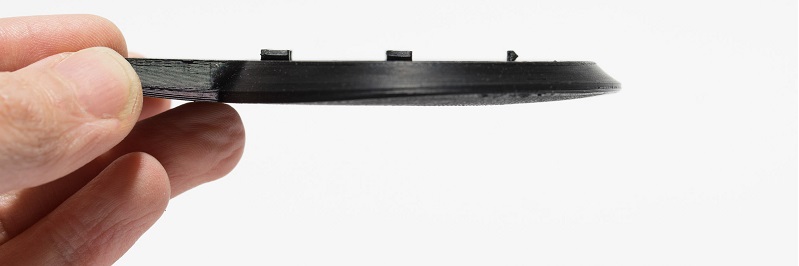
The choices of the designer can also reduce the probability of warping:
1.Large flat areas (think of a rectangular box) are more prone to warping and should be avoided when possible.
2.Thin protruding features (think of the prongs of a fork) are also prone to warping. In this case, warping can be avoided by adding some sacrificial material at the edge of the thin feature (for example a 200 microns thick rectangle) to increase the area that touches the build platform.
3.Sharp corners are warping more often than rounded shapes, so adding fillets to your design is a good practice.
4.Different materials are more susceptible to warping: ABS is generally more sensitive to warping compared to PLA or PETG, due to its higher glass transition temperature and relatively high coefficient of thermal expansion.
Layer Adhesion
Good adhesion between the deposited layers is very important for an FDM part. When the molten thermoplastic is extruded through the nozzle, it is pressed against the previous layer. The high temperature and the pressure re-melts the surface of the previous layer and enables the bonding of the new layer with the previously printed part.
The bond strength between the different layers is always lower than the base strength of the material.
Support Structure
Support structure is essential for creating geomentries with overhangs in FDM. The melted thermoplastic cannot be deposited on thin air. For this reason, some geometries require support structure.
Surfaces printed on support will generally be of lower surface quality than the rest of the part. For this reason, it is recommended that the part is designed in such a way to minimize the need for support.
Support is usually printed in the same material as the part. Support materials that dissolve in liquid also exist, but they are used mainly in high-end desktop or industrial FDM 3D printers. Printing on dissolvable supports improves significantly the surface quality of the part, but increases the overall cost of a print, as specialist machine (with dual extrusion) are required and because the cost of the dissolvable material is relatively high.
Infill & Shell Thickness
FDM parts are usually not printed solid to reduce the print time and save material. Instead, the outer perimeter is traced using several passes, called the shell, and the interior is filled with an internal, low-density structure, called the infill.
Infill and shell thickness affect greatly the strength of a part.
Post Processing
FDM parts can be finished to a very high standard using various post-processing methods, such as sanding and polishing, priming and painting, cold welding, vapor smoothing, epoxy coating and metal plating.
Standard:
FDM parts are built with support material that is removed during post-processing. The part surfaces are left with fine layer lines.
Custom:
Galaxy3DM can provide additional processing (i.e. painting or sanding) to meet your needs.
Galaxy3DM Common FDM Materials

One of the key strengths of FDM is the wide range of available materials. These can range from commodity thermoplastics (such as PLA and ABS) to engineering materials (such as PA, TPU, and PETG) and high-performance thermoplastics (such as PEEK and PEI).
The material used will affect the mechanical properties and accuracy of the printed part, but also its price. The most common FDM materials are summarized in the table below. A review of the main differences of PLA and ABS, the two most common FDM materials, and an extensive comparison of all common FDM materials can be found in the dedicated articles.

Thermoplastic materials pyramid available in FDM. As a rule of thumb, the higher a material is the better its mechanical properties.
The material used will affect the mechanical properties and accuracy of the printed part, but also its price. The most common FDM materials are summarized in the table below. A review of the main differences of PLA and ABS, the two most common FDM materials.
Part of Common Material for Fused Deposition Modeling (FDM) | |
Materials | Thermoplastics (PLA, ABS, PETG, PC, PEI etc) |
Dimensional accuracy | ± 0.5% (lower limit ± 0.5 mm) - desktop± 0.15% (lower limit ± 0.2 mm) - industrial |
Typical build size | 200 x 200 x 200 mm - desktop1000 x 1000 x 1000 mm - industrial |
Common layer height | 50 to 400 microns |
Support | Not always required (dissolvable available) |
Material | Characteristics |
ABS | Good strength |
Good temperature resistance | |
More susceptible to warping | |
PLA | Excellent visual quality |
Easy to print with | |
Low impact strength | |
Nylon (PA) | High strength |
Excellent wear and chemical resistance | |
Low humidity resistance | |
PETG | Food Safe* |
Good strength | |
Easy to print with | |
TPU | Very flexible |
Difficult to print accurately | |
PEI | Excellent strength to weight |
Excellent fire and chemical resistance | |
High cost | |
PEEK | heat resistant up to 260°C; |
chemical resistant to corrosive fluids and gases; | |
high pressure resistant; | |


 複製產品鏈接
 長按圖片保存/分享
詢盤
谘詢表單:
谘詢內容:

你還沒有添加任何產品

詢盤
谘詢表單:
谘詢內容:
你還沒有添加任何產品


86-13143415646
Contact:
 Tel: 86-755-23000620 Fax: 86-755-23000621
 Email:info@galaxy3dm.com/info@seetoptech.com
 Address: A3 , Dingfeng Industrial Zone, Fuyong Town, Shenzhen, China
Galaxy 3D Manfacturing Solution
Copyright (©) 2020 Shenzhen Seetop Technology Co.,Limited
