


SLM 3D Printing
SLMSelective laser melting, or SLM, is a type of metal additive manufacturing or 3D printing.
SLM
Selective laser melting, or SLM, is a type of metal additive manufacturing or 3D printing. Often, the terms SLM and direct metal laser sintering (DMLS) are used interchangeably. However, the two technologies differ slightly, in that SLM melts pure metals while DMLS fuses metal alloys.
SLM is one of the most exciting 3D printing technologies available today and is utilized both for rapid prototyping and mass production. The range of metal alloys available is fairly extensive. The end result has properties equivalent to those manufactured via traditional manufacturing processes.
SLM is a great alternative for traditional manufacturing methods. Here are the pros and cons of producing a model via SLM as opposed to traditional methods.

SLM 3D printing Main Parameter:
| TECHNICAL DATA | |
| External Dimensions (LxWxH) | 2700 × 1290 × 2290 mm |
| Build Cylinder Size1 (LxWxH) | 425 × 425 × 420 mm (not including build plate thickness) |
| Net Weight | Approx. 3450KG (Single laser) / 3500KG (Dual laser) |
| Layer Thickness | 0.02 - 0.1 mm |
| Scanning Speed | Max. 15.2 m/s |
| Laser Type | Dual fiber laser, 2 × 500W or Single fiber laser, 1 × 500W |
| Scanner | High-precision three-axis digital galvo system |
| Laser Spot Size | Approx. 70 μm contour, 70-200μm fill |
| Average Inert Gas Consumption in Process | <3 L/min. (Argon/Nitrogen) |
| Operating System | 64 bit Windows 10 |
| Comprehensive Software | BuildStar®, MakeStar® |
| Key Software Features | Open machine key parameters, real-time build parameter modification, three-dimensional visualization, diagnostic functions |
| Data File Format | STL |
| Power Supply | EUR/China: 380-400V, 50/60Hz, three-phase. US: transformer sold with machine |
| Operating Ambient Temperature | 22-28°C |
| Materials | AlSi10Mg,Ti6Al4V, 316L, IN718, GH3536,TA15 |

Advantages:
Large range of metals available
Ability to realize complex shapes or internal features (which would be incredibly difficult or expensive to achieve via traditional manufacturing)
Reduced lead times, due to no need for tooling
Part consolidation, allowing the production of multiple parts at the same time
Drawbacks:
Expensive, especially if parts aren’t optimized or designed for the process
Specialized design and manufacturing skills and knowledge needed
Limited currently to relatively small parts
Rough surface finish
Lots of post-processing required
Applications of metal 3D printing:
Space
Creating lightweight structures is of paramount importance for the space industry. The current cost of launching a kilogram of payload into space is approximately $10,000 to $20,000. So, metal 3D printing of topology optimized parts has great potential here.
Healthcare
The ability to create organic structures, personalized to the anatomy of every individual, makes metal 3D printing a very appealing solution for the medical industry. Today, medical implants from biocompatible materials (such as titanium) are one of the major uses of metal 3D printing.
Automotive
The adoption of metal 3D printing as a manufacturing option for end parts in the automotive industry is increasing rapidly. For the time being, high-performance and racing are the main applications of metal 3D printing.
Industrial Tooling
Metal 3D printing is used today to create industrial tools with added functionality. These advanced tools can greatly increase the productivity of other proceses.
Product Development
The main applications of Metal Extrusion today is the manufacture of metal prototypes. When compared to other in-house solutions, the time savings offered by Metal Extrusion can greatly reduce the time-to-market of new engineering products.
Selective laser melting, or SLM, is a type of metal additive manufacturing or 3D printing. Often, the terms SLM and direct metal laser sintering (DMLS) are used interchangeably. However, the two technologies differ slightly, in that SLM melts pure metals while DMLS fuses metal alloys.
SLM is one of the most exciting 3D printing technologies available today and is utilized both for rapid prototyping and mass production. The range of metal alloys available is fairly extensive. The end result has properties equivalent to those manufactured via traditional manufacturing processes.

SELECTIVE LASER MELTING (SLM)
How Does It Work?
SLM is very similar to SLS, and both processes are covered under the powder bed fusion umbrella. The major difference is the type of feedstock or powder it uses. While SLS uses mainly nylon (PA) polymer materials, SLM is specifically for metals.
Nevertheless, the basic process is the same. As demonstrated in the image above, the laser sinters the powder together, layer-by-layer, until the model is complete.
However, there is one big difference between SLM and SLS. Due to the constraints of the SLM process and the weight of the material, SLM requires support structures to be added to any overhanging features. This differs from SLS, where the surrounding powder material can provide enough support, allowing freeform shapes and features to be realized.

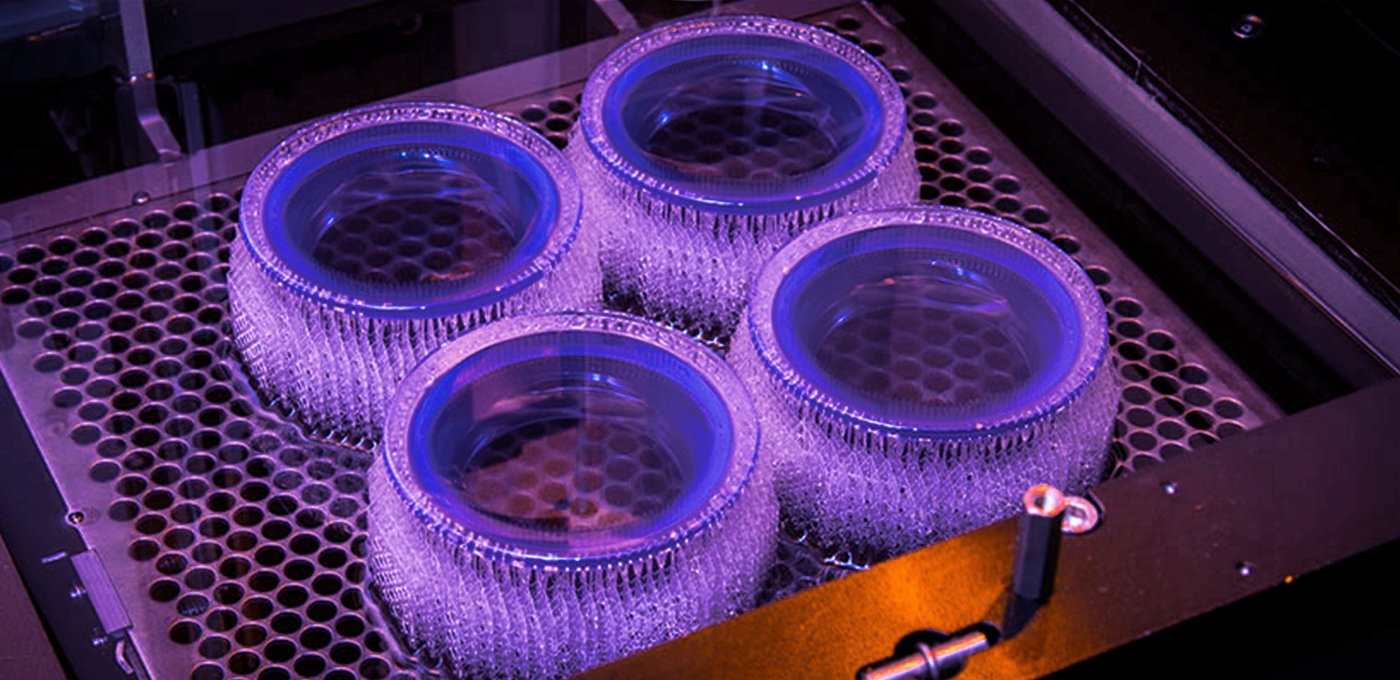
An SLM machine has a chamber filled with metal powder. This metal powder is then spread across the substrate or build plate in very thin layers by a coater blade.
A high power laser then fuses a 2D slice of the part by selectively melting the powdered material. The build plate then drops down by the height of one layer, and the coater spreads another layer of fresh powder finely across the surface. The process is repeated until you have the finished part.
This whole process is performed in a controlled atmosphere inside the machine. Once the part is built, it can be removed from the machine. SLM parts need to be removed from the build plate, which is often done with a bandsaw. Then you need to remove the supports. As the support material is the same as the part material, this can be difficult and a time-consuming process.
The surface finish of the sintered parts is rough and, depending on your requirements, may need some post-processing. It is also common to machine parts to achieve fine tolerances and finish fine features, surfaces, and holes.
SELECTIVE LASER MELTING (SLM) Pros and Cons
SLM is a great alternative for traditional manufacturing methods. Here are the pros and cons of producing a model via SLM as opposed to traditional methods.
Advantages
- Large range of metals available
- Ability to realize complex shapes or internal features (which would be incredibly difficult or expensive to achieve via traditional manufacturing)
- Reduced lead times, due to no need for tooling
- Part consolidation, allowing the production of multiple parts at the same time
Drawbacks
- Expensive, especially if parts aren’t optimized or designed for the process
- Specialized design and manufacturing skills and knowledge needed
- Limited currently to relatively small parts
- Rough surface finish
- Lots of post-processing required
Materials for Metal 3D printing
The number of metal material available for metal 3D printing is growing rapidly. Engineers can today select from alloys including:
Stainless steels,
Tool steels
Titanium alloys
Aluminum alloys
Nickel-based superalloys
Cobalt-chrome alloys
Copper-based alloys
Precious metals (gold, silver, platinum...)
Exotic metals (palladium, tantalum...)
The cost of metal 3D printing
The cost of a metal 3D printer varies greatly between technologies. The selling price of a DMLS/SLM printer averages at $550,000 and can reach $2 million USD. Metal Binder Jetting systems cost approximately $400,000. A Metal Extrusion printer will cost you around $140,000 including the post-processing units.
The manufacturing cost of a typical DMLS/SLM part is approximately $5,000-$10,000 (including finishing). For Binder Jetting and Metal Extrusion, the cost per parts can be up to 5-10 times lower than that of DMLS/SLM parts. At the time of writing though, it is still early to assess the full operational cost of these systems.
The table below is a break down of the average costs of different manufacturing steps for DMLS/SLM. Notice that the material cost, as well as the cost of post-processing, contribute considerably to the overall cost.
| Production Technology | Opoeration | Cost |
Manufacturing | Material cost | $200 - $500 per kilogram |
DMLS/SLM cost | $2,000 - $4,000 per build † | |
Post-processing | Stress relief | $500 - $600 per build † |
Part/supports removal | $100 - $200 per part | |
Heat treatment / HIP | $500 - $2,000 per build † | |
CNC machining | $500 - $2,000 per part | |
Surface treatments | $200 - $500 per part |
† Typically, six to twelve parts can fit on the same build plate.
The speed of metal 3D printing
Independent of the process, a metal 3D printed part requires at least 48 hours and an average of 5 days to manufacture and finish.
About 50% of the total production time is allocated to printing. This, of course, depends on the volume of the part and the need for support structures. For reference, the current production rate of modern metal 3D printing systems varies between 10-40 cm³/h.
The remaining production time is related to post-processing and finishing requirements. Thermal treatments contribute significantly to the total production time: a typical thermal cycle lasts 10 to 12 hours. Mechanical surface finishes can also be a time-consuming step as they need input from an expert (5-axis CNC machining) or manual labor (hand polishing).
Metal 3D printing vs traditional manufacturing
Always begin with a Cost vs Performance analysis, when you are choosing between a metal 3D printing and a subtractive (CNC machining) or formative (metal casting) technology.
Generally speaking, the manufacturing cost is mainly connected to the production volume, while the performance of a part depends greatly on its geometry.
The key strength of metal 3D printing is its ability to create parts with complex & optimized geometries. This means that it is ideal for manufacturing high-performance parts. On the other hand, it does not scale as well as CNC machining or metal casting at higher volumes.
| Quantity | Low complexity | Header | Header |
| < 10 parts | CNC machining | Metal extrusion | DMLS/SLM |
| CNC machining | |||
| < 100 parts | CNC machining | Binder Jetting | Binder Jetting |
| CNC machining | DMLS/SLM | ||
| < 1,000 parts | CNC machining | Binder Jetting | Binder Jetting |
| Metal casting | CNC machining | ||
| 1,000+ parts | Sheet Metal | Metal casting | - |
| Metal casting |
Materials for Metal 3D printing

The number of metal material available for metal 3D printing is growing rapidly. Engineers can today select from alloys including:
Stainless steels,Tool steels,Titanium alloys,Aluminum alloys,Nickel-based superalloysCobalt-chrome alloys,
Copper-based alloys,Precious metals (gold, silver, platinum...),Exotic metals (palladium, tantalum...)
SLM Material List Part1:
TA15 | Titanium
Titanium alloy Exceptional strength to weight properties with outstanding corrosion resistance,high temperature strength and non-magnetic property
GH3536 | Inconel
Good oxidation and corrosion resistance, Excellent mechanical properties, Different properties can be obtained by heat treatment
CoCrMoW | Cobalt Chrome
Excellent mechanical property, Remarkable biocompatibility, Outstanding corrosion resistance
15-5PH | Stainless Steel
Excellent mechanical properties, Good corrosion resistance, Different properties can be obtained by heat treatment
IN718 | Inconel
High Nickel alloy with excellent mechanical performance, oxidation and corrosion resistance under high temperature and stress.
IN625 | Inconel
Nickel Chrome alloy with excellent tensile strength, creep strength and fatigue resistance. Good oxidation and corrosion resistance. can be hot and cold formed and is readily weldable
CuSn10 | Bronze
Copper alloy with excellent corrosion resistance, heat and electric conductivity.
420 | Stainless Steel
Stainless steel with excellent stiffness and abrasion resistance with good machinability
18Ni300 | Maraging Steel
Tool steel with good machining and welding properties,
AlSi10Mg | Aluminum
Aluminum alloy with good corrosion resistance and high heat and electrical conductivity
Ti6Al4V | Titanium
Titanium alloy Exceptional strength to weight properties with outstanding corrosion resistance,high temperature strength and non-magnetic property
CoCrMo | Cobalt Chrome
Cobalt Chrome has excellent mechanical properties at high temperatures and is well know for its bio-compatibility
17-4PH | Stainless Steel
Stainless Steel with good machinability, magnetic properties, percipitation hardenable
316L | Stainless Steel
Stainless Steel with exceptionally weldability and good corrosion resistance, non-magnetic
Specialized Materials
For specialized materials such as Tungsten and Tantalum, please contact Farsoon with your inquires or requirements.
The Economics of MIM Versus 3D Metal Printing
Metal 3D Printing is becoming a great complement to Metal Injection Molding (MIM) and the decision to use one or the other largely comes down to the volumes required. The added bonus with metal 3D printing is that you can update a part without needing to invest in a brand new mold.
Manufacturers today who are searching for a cost-effective way to make small and complex metal parts for production by and large only have two options: metal injection molding (MIM) or investment casting. Casting has been around for thousands of years, and MIM was created ~40 years ago. Metal 3D printing is the new entrant to the scene, and for the first time in a long while adds another option to the engineer’s toolkit. New low-cost, high volume metal 3D printing technologies (like 3DEO) are beginning to change conventional manufacturing wisdom.

Different AM technologies
Metal-based AM processes were developed in the 1990s and introduced to the market soon after. There are many different AM metal technologies available today. Some of the more widespread are listed below. The table gives an overview of the strengths and weaknesses of each technology.
Small series | Part complexity | Productivity | Surface finish | Resolution | Part size | Materials | |
SLM | ++ | ++ | 0 | 0 | + | + | ++ |
EBM | ++ | ++ | + | – | – | + | 0 |
DED | ++ | + | ++ | — | — | ++ | + |
Digital Metal | ++ | ++ | + | + | ++ | – | + |
MIM | — | 0 | ++ | ++ | ++ | – | ++ |
Digital Metal capability comparison
The table above, produced by Digital Metal, offers an at-a-glance comparison of its technology and alternative manufacturing processes, based on its industry experience. It compares AM processes like SLM (Selective Laser Melting), EBM (Electron Beam Melting), DED (Direct Energy Deposition) and conventional technology like MIM (Metal Injection Moulding) with Digital Metal’s high precision binder jetting.
All AM technologies have their pros and cons, every organisation must consider what’s best for their application needs. All AM technologies are advantageous for prototyping or small series production but the greater amount of energy used during melting for higher productivity results in a tradeoff of less intricacy and limited surface resolution, while MIM is only 2D and productive for really small applications.
Comparatively Digital Metal offers a unique combination as it provides high precision details, fine surfaces, print tolerances, and high productivity of multiple parts in a single print that be either uniform or customised.
The Long Road of MIM
Today MIM has matured into a core manufacturing technology and is widely used in the production of small components for a variety of industries and a large number of material options. This was not always the case — when MIM first came onto the manufacturing scene over 30 years ago, it suffered setbacks due to lack of process understanding and new entrants flooding onto the scene. Part repeatability, voids, and fatigue issues plagued many MIM providers and the poor part performance soured the reputation for many manufacturing engineers. It was seen as a manufacturing technology of last resort, only to be considered when all other avenues of production had been exhausted or when cutting costs was prioritized over part performance.
MIM has come a long way since the early days, and today’s best MIM operations have proven that MIM is capable of reliable high-volume production and strong material properties. There are still pros and cons associated with MIM, which this article will further explore.
MIM is used to create components in numerous markets including medical, firearms, general industrial, and many others. When a part design is not likely to change for the next 5 to 10 years because it is part of a long design-in cycle and the volumes will be in the hundreds of thousands to millions, then investing in MIM tooling can make a lot of sense from an economic perspective. One of the main headaches for manufacturing engineers when using MIM is having to write the check for the mold (which can cost as much as $50K – $100K). If you know the cost of the mold will be quickly amortized over millions of parts, then the investment could make a lot of sense.
Metal 3D Printing — Freedom from the Mold
While MIM has been the choice for very high volumes of small and complex components of late, many design and manufacturing engineers have been rooting for a metal 3D printing technology to find a way to make printing metal parts an economical alternative to MIM. Most engineers’ frustration with MIM, aside from the high-cost tooling, is being limited to a single component per mold. If you want to make 10 different parts, you need to invest in 10 different molds. You want to make a small feature change? Yes, that means modifying the existing mold, fixing the parts in post processing, or getting a completely new mold.
Metal additive manufacturing holds the promise of freedom from the mold. Changing the design of the part is as easy as updating a computer file.
What has held metal additive manufacturing back from high-volume production has been the VERY high cost per part. The machines for powder bed fusion technologies such as SLM can cost well over a million dollars, and materials can cost as much as $150 per pound. Those costs, in addition to other labor and infrastructure costs, translate directly into a prohibitively high part cost.
Metal 3D Printing — Unlimited Design Freedom
MIM has more constraints regarding the part geometry than metal 3D printing. This is due to the need for a mold and forcing binder and powder under high pressures, and then opening the mold and extracting the green parts. The mold is great for a highly automated process, but also comes with drawbacks. On the other hand, when creating parts via 3D on a layer-by-layer basis, new design freedom is possible. Unlike MIM, additional complexity does not also result in additional mold and production costs.
Metal Additive Manufacturing Meets Low Cost
The demand for a low-cost metal additive manufacturing technology is extremely high. Advances in bind & sinter technologies have given new hope for metal additive manufacturing to compete on a cost-per-part basis. Bind & sinter is a category of metal 3D printing that uses a binder in a layer-by-layer process to create a “green part” that is then placed in a sintering furnace to reach full density. It’s expensive to reach over 2,400 °F no matter what process is used, and reaching it every layer is what drives up the cost of powder bed fusion. By printing green parts in high volumes on lower cost machines and then bulk sintering all the parts at once, the cost is significantly reduced. What separates different bind & sinter technologies is how the green part is created.
When to Use Metal AM vs. MIM
Bind & sinter technologies are dramatically driving down the price-per-part for metal additive manufacturing, but how do they compare to MIM? The best bind & sinter technologies today are a great option when volumes are well above prototyping but below the break-even cost of investing in the MIM tool. This decision partially depends on the cost of the mold and is usually when production volumes head north of 20,000 to 30,000 pieces per year. At volumes just below that, it is often more cost effective to have your parts manufactured with a low-cost bind & sinter technology.
It’s important to remember the freedom offered by metal additive manufacturing with regard to design flexibility. In addition to being able to create geometries not possible with MIM, updating a design is trivial with metal 3D printing as compared to buying a new mold every time a change is needed. Molds also need maintenance after high production volumes and eventually will require repairs or replacement.
Manufacturers working on their new products and researching the most cost-effective way to manufacture small and complex parts need to be investigating bind & sinter technologies. The cost analysis can be done quickly to determine whether MIM is the best option or whether metal additive manufacturing is the most cost-effective path forward.


 复制产品链接
 长按图片保存/分享
询盘
咨询表单:
咨询内容:

你还没有添加任何产品

询盘
咨询表单:
咨询内容:
你还没有添加任何产品


86-13143415646
Contact:
 Tel: 86-755-23000620 Fax: 86-755-23000621
 Email:info@galaxy3dm.com/info@seetoptech.com
 Address: A3 , Dingfeng Industrial Zone, Fuyong Town, Shenzhen, China
Galaxy 3D Manfacturing Solution
Copyright (©) 2020 Shenzhen Seetop Technology Co.,Limited
